


Maxime Toquebiau, PhD
Postdoctoral Researcher in Language Evolution, at VUB AI Research Group
Cultural Evolution Drives the Emergence of Conventions in Neural Emergent Communication
Maxime Toquebiau, Jérôme Botoko Ekila, Paul Van Eecke, and Katrien Beuls
Conference on Empirical Methods in Natural Language Proceedings (EMNLP), 2026
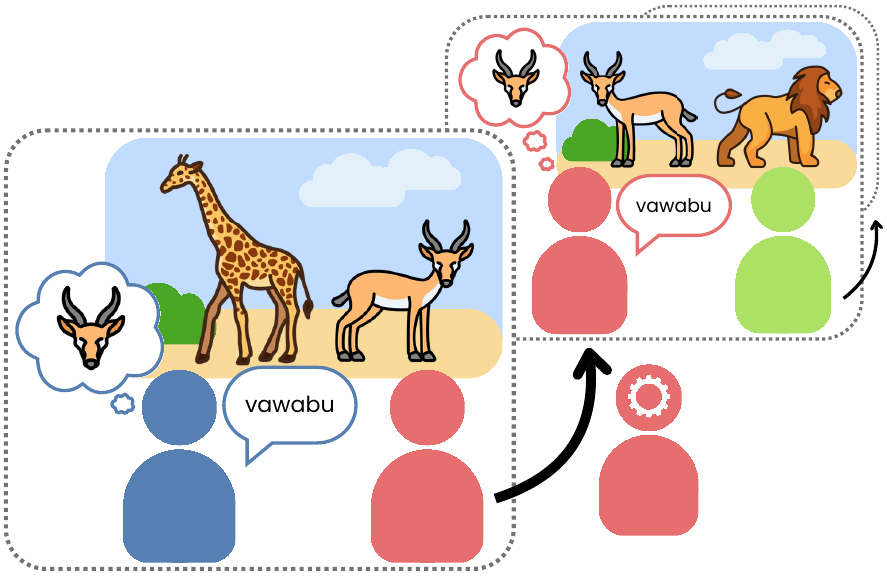
Abstract. Recent studies of language evolution with neural agents often use models where agents can either speak or listen, where there are only two agents in the population, or where agents can share internal representations. These choices prevent the study of how language emerges through cultural evolution, i.e. through the cumulative adaptation of individual behaviours to fit the communicative needs of the community. We tackle this issue with a new model that trains populations of bi-directional neural agents in a fully distributed fashion to solve a referential game. We demonstrate the effectiveness of this approach on multiple image datasets and show that it is able to scale to large populations. We also show that more conventional languages are easier to learn, providing a direct advantage for cultural transmission. Overall, this work provides a novel approach to neural emergent communication that opens up new directions for evolutionary linguistics.
 Pre-print
Towards Language-Augmented Multi-Agent Deep Reinforcement Learning
Maxime Toquebiau, Jae-Yun Jun Kim, Faïz Ben Amar, Nicolas Bredeche
European Conference on Artificial Intelligence (ECAI), 2025
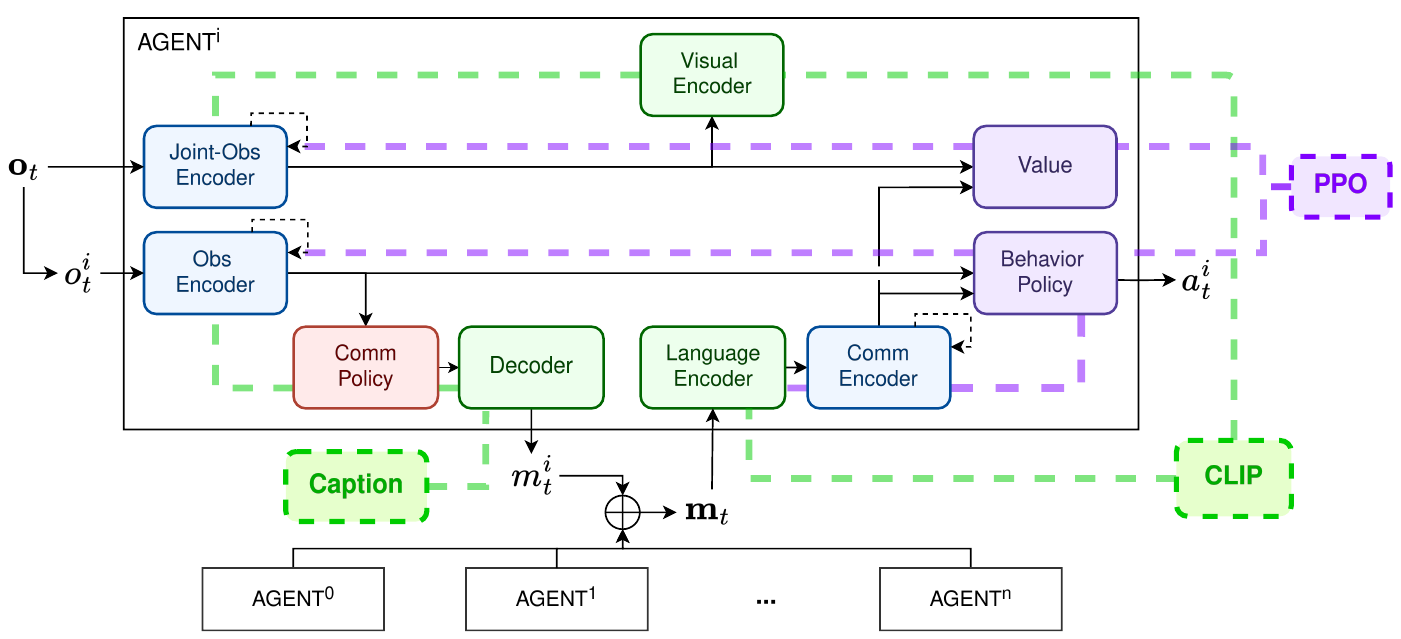
Abstract. Most prior works on communication in multi-agent reinforcement learning have focused on emergent communication, which often results in inefficient and non-interpretable systems. Inspired by the role of language in natural intelligence, we investigate how grounding agents in a human-defined language can improve the learning and coordination of embodied agents. We propose a framework in which agents are trained not only to act but also to produce and interpret natural language descriptions of their observations. This language-augmented learning serves a dual role: enabling efficient and interpretable communication between agents, and guiding representation learning. We demonstrate that language-augmented agents outperform emergent communication baselines across various tasks. Our analysis reveals that language grounding leads to more informative internal representations, better generalization to new partners, and improved capability for human-agent interaction. These findings demonstrate the effectiveness of integrating structured language into multi-agent learning and open avenues for more interpretable and capable multi-agent systems.
@InProceedings{Toquebiau2025_LAMARL,
author = {Toquebiau, Maxime and Jun, Jae-Yun and Benamar, Faïz and Bredeche, Nicolas},
booktitle = {28th European Conference on Artificial Intelligence, 25-30 October 2025, Bologna, Italy – Including 14th Conference on Prestigious Applications of Intelligent Systems (PAIS 2025)},
title = {Towards Language-Augmented Multi-Agent Deep Reinforcement Learning},
year = {2025},
series = {Frontiers in Artificial Intelligence and Applications},
volume = {413},
doi = {10.3233/FAIA251260},
}
Signalling and social learning in swarms of robots
Leo Cazenille, Maxime Toquebiau, Nicolas Lobato-Dauzier, Alessia Loi, Loona Macabre, Nathanaël Aubert-Kato, Anthony J. Genot, Nicolas Bredeche
Philosophical Transactions of the Royal Society A, 2025
Abstract. This paper investigates the role of communication in improving coordination within robot swarms, focusing on a paradigm where learning and execution occur simultaneously in a decentralized manner. We highlight the role communication can play in addressing the credit assignment problem (individual contribution to the overall performance), and how it can be influenced by it. We propose a taxonomy of existing and future works on communication, focusing on information selection and physical abstraction as principal axes for classification: from low-level lossless compression with raw signal extraction and processing to high-level lossy compression with structured communication models. The paper reviews current research from evolutionary robotics, multi-agent (deep) reinforcement learning, language models and biophysics models to outline the challenges and opportunities of communication in a collective of robots that continuously learn from one another through local message exchanges, illustrating a form of social learning.
Multi-Agent Deep Reinforcement Learning in Robotics: Context and Open Challenges
Maxime Toquebiau, Jae-Yun Jun Kim, Faïz Ben Amar, Nicolas Bredeche
2025
Abstract. Real-world environments frequently involve multiple interacting entities whose behaviours co-evolve, making learning and decision-making fundamentally more complex than in the single-agent setting. Multi-agent deep reinforcement learning (MADRL) addresses such scenarios by developing new techniques inspired from multi-agent systems and deep reinforcement learning. One objective of this research to tackle robotic settings, where teams of robots must coordinate, cooperate, or compete under real-world constraints. Yet, despite progress on algorithms, several gaps remain between MADRL research and practical robotic deployment. This survey provides a structured overview of MADRL from the perspective of robotic applications. We first formalise key concepts of multi-agent learning and challenges introduced by decentralisation, non-stationarity, partial observability, and coordination. We then analyse how these challenges intersect with robotics-specific considerations such as embodiment, safety, and sim-to-real transfer. Following this, we survey the MADRL literature, outlining the main research directions in the field from the last decade. Finally, we reflect on the shortcomings of current approaches and identify avenues for advancing cooperative MADRL towards scalable, robust, and deployable multi-robot intelligence.
@TechReport{Toquebiau2025_MADRL,
author = {Toquebiau, Maxime and Jun Kim, Jae-Yun and Ben Amar, Faïz and Bredeche, Nicolas},
institution = {Sorbonne University},
title = {Multi-Agent Deep Reinforcement Learning in Robotics: Context and Open Challenges},
year = {2025},
url = {https://maxtoq.github.io/docs/Preprint_MADRL.pdf},
}
Joint Intrinsic Motivation for Coordinated Exploration in MADRL
Maxime Toquebiau, Nicolas Bredeche, Faïz Ben Amar, Jae-Yun Jun Kim
Proceedings of the 23rd International Conference on Autonomous Agents and Multiagent Systems (AAMAS 2024)
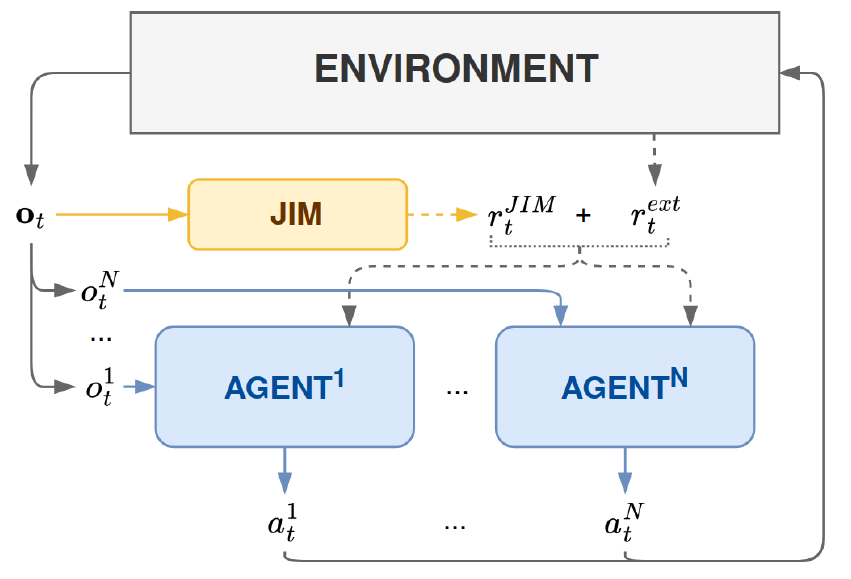
Abstract. Multi-agent deep reinforcement learning (MADRL) problems often encounter the challenge of sparse rewards. This challenge becomes even more pronounced when coordination among agents is necessary. As performance depends not only on one agent's behavior but rather on the joint behavior of multiple agents, finding an adequate solution becomes significantly harder. In this context, a group of agents can benefit from actively exploring different joint strategies in order to determine the most efficient one. In this paper, we propose an approach for rewarding strategies where agents collectively exhibit novel behaviors. We present JIM (Joint Intrinsic Motivation), a multi-agent intrinsic motivation method that follows the centralized learning with decentralized execution paradigm. JIM rewards joint trajectories based on a centralized measure of novelty designed to function in continuous environments. We demonstrate the strengths of this approach both in a synthetic environment designed to reveal shortcomings of state-of-the-art MADRL methods, and in simulated robotic tasks. Results show that joint exploration is crucial for solving tasks where the optimal strategy requires a high level of coordination.
Contact
E-mail: maxime.toquebiau@vub.be